Entity-Relationship Data Model
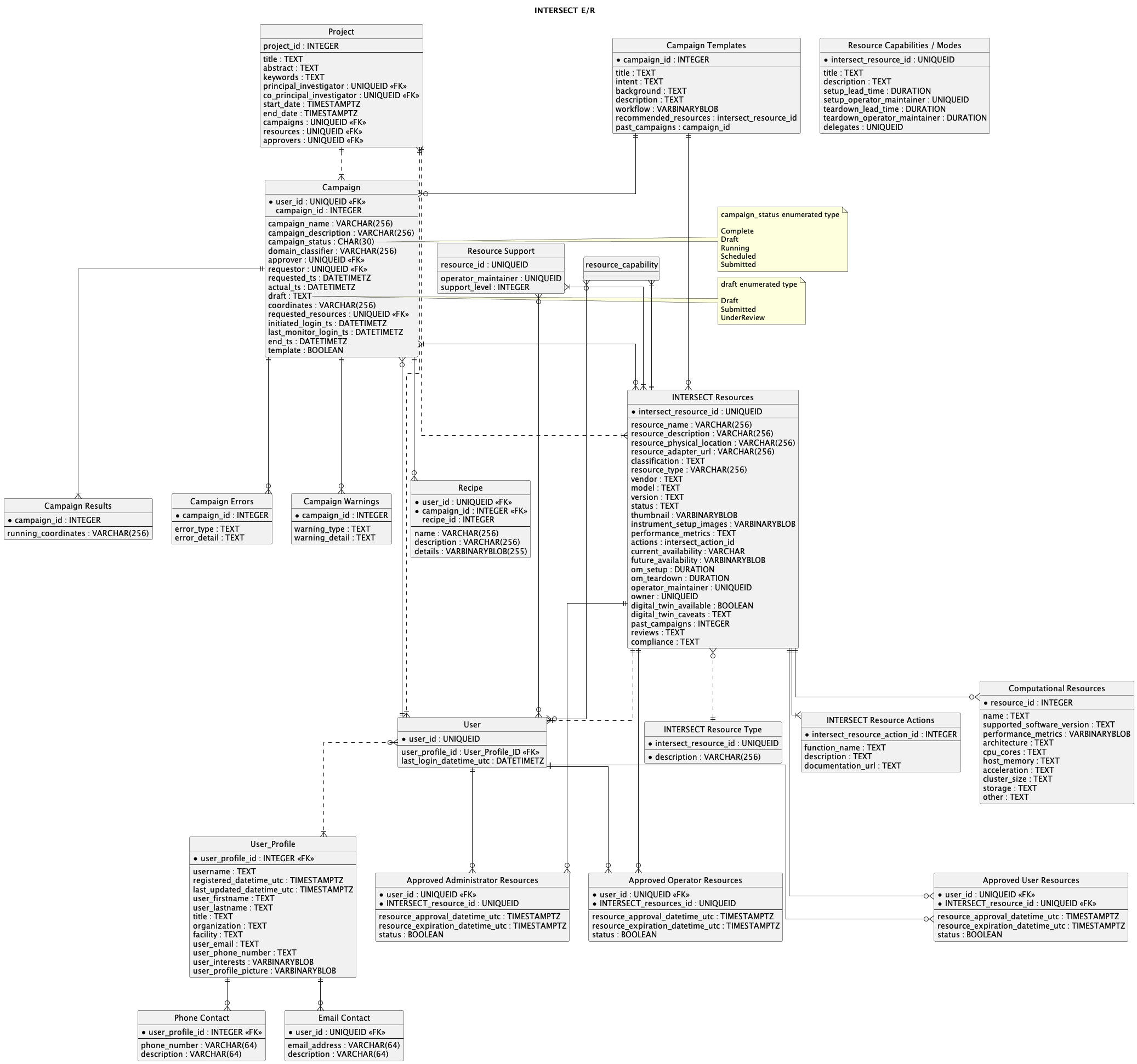
This section describes the entity-relationship data model of the INTERSECT ecosystem, as depicted in Fig. 109. Table 17 presents detail on the entities shown in Fig. 109.
Entity Name |
Description |
|---|---|
User |
A user of an INTERSECT-compliant system or application. May participate in authentication or authorization processes. |
User Profile |
Profile information (contact/address/miscellaneous) for an INTERSECT user. |
Project |
Accounting abstraction for resource allocation in an INTERSECT system. |
Campaign |
A collection of related experimental activity which uses INTERSECT resources. A Campaign is associated with a Project and may have multiple Users associated with it. Campaigns have explicit durations and discrete sets of resources assigned to them. |
Campaign Result |
Outcomes of INTERSECT Campaigns. There may be several different result states represented. |
Campaign Error |
|
Campaign Template |
It may prove useful to memoize a Campaign structure as a template, so that it may be quickly replicated by users. Such repllicated new Campaigns are assigned the tamplated INTERSECT resources. |
Recipe |
Users may also wish to reuse resource structures at a finer granularity than Campaign. Recipies allow this usage to be memoized. |
Approved User Resources
Approved Administrator Resources
Approved Operator Resources
|
Resource allocations are tracked with approval durations for each of Users, Administrators, and Operators. |
INTERSECT Resource Type |
Additional information about an INTERSECT resource. |
INTERSECT Resource Action |
Detail on the operations/functions available from a given INTERSECT resource. |
INTERSECT Resources |
Experimental/physical, computational, or virtual facilities available within the INTERSECT system or application. |
Computational Resource |
Additional information about computational resources available to the INTERSECT system or application. |
Resource Support |
An INTERSECT resource may be large and complex, requiring specialized support procedures and/or personnel for operation. Computational resources, for example, may have multiple such support staff, organized into tiers or functional areas. |
Resource Capability |
Resources provide INTERSECT capabilities, which allow them to be composed into systems and applications within the INTERSECT Architecture. |